
Image

Synergy Enterprises, Inc. (Synergy) offers a range of strategic communications services. From communications research and content development to social marketing and stakeholder outreach, we pride ourselves on our integrated approach to planning, execution, and evaluation. However, one of our lesser-known communications and information technology (IT) capabilities is in Section 508 compliance.
According to the Centers for Disease Control and Prevention, 26 percent (1 in 4) of adults in the United States have some type of disability. Section 508 is a section of the Rehabilitation Act of 1973, a collection of laws and guidelines requiring information to be made available to the public regardless of sensory disability. This includes individuals with visual, auditory, motor, and cognitive impairment. Added in 1998, Section 508 was enacted to eliminate barriers in IT and to make available new opportunities for people with disabilities. This law applies to federal agencies when they develop, procure, maintain, or use electronic and IT to develop Government Information and Communications Technology (ICT). Examples of ICT include, but are not limited to:
Section 508 may be foreign to you if you’re not a federal office or contractor. However, many organizations may still abide by Section 508 standards, and if you create content for an organization that receives federal funding, you may be required to meet 508 standards. These regulations are overseen by the U.S. Access Board, an agency of the U.S. Department of Health & Human Services.
At Synergy, we ensure your content is accessible for this important audience. Our compliance specialists keep pace with the latest technical developments and trends for comprehensive accessibility. We conduct quality assurance reviews using up-to-date, gold standard tools and 508 compliance diagnostic software. Additionally, we can provide formal training or tips to help simplify 508 compliance testing and assurance. Our clients include the U.S. Department of Education’s National Center for Education Statistics, National Center for Homeless Education, NIH’s National Institute on Drug Abuse, and the Office of Research on Women’s Health, among others. Learn more about our Section 508 compliance clients here.
When checking ICT for 508 compliance, ask yourself: Can the user navigate the website without using a mouse? Are the items readable by screen reader for visually impaired users? Is there closed captioning for audio or video content? These are just some of the requirements for Section 508 compliance. Below we offer some tips you can use to ensure your content is up to code:
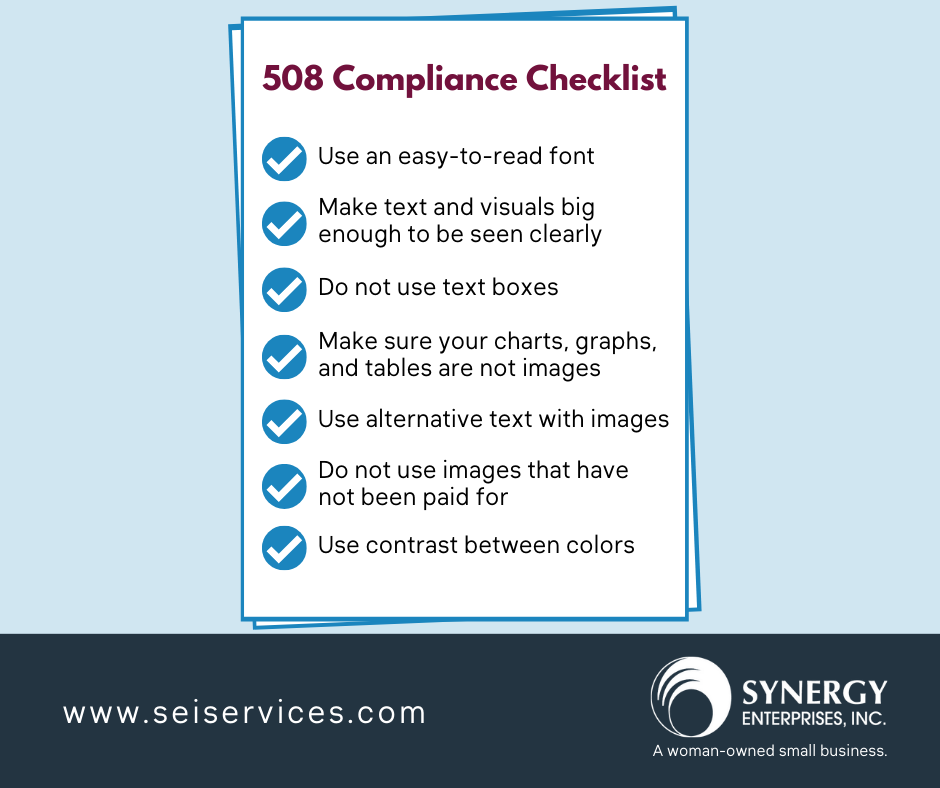
Technology makes things easier to access, but design still needs to be addressed for ease of use for everyone. Thanks to Section 508, there is now a federal standard set for the commercial industry to adhere to. It shows that accessibility can and should be prioritized. Even if your business is not required to follow Section 508, improving the accessibility of your digital assets promotes equal access for all.