
Image

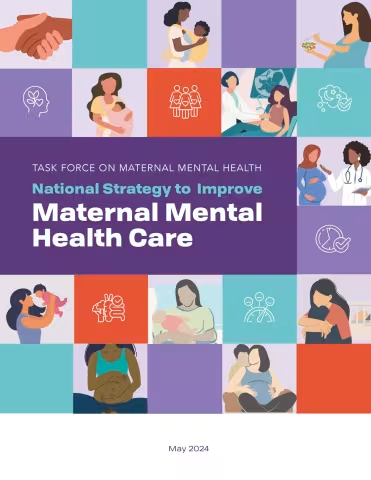
“Confident—that’s how I felt when I learned that Synergy Enterprises would be a key player in producing the Task Force on Maternal Mental Health’s national strategy and report to Congress. Both products are of the utmost importance in saving and improving the lives of perinatal people and their families. Accuracy, accessibility, actionability, and an extremely quick turnaround were essential—and Synergy has the subject matter expertise, credentialed staff, and experience developing reports of this importance needed to do a great job,” explained Elaine McCarthy (formerly Rahbar), Vice President of Strategic Communications at Synergy. The task force was co-led by staff members at the U.S. Department of Health and Human Services (HHS) Office of the Assistant Secretary for Health (OASH) and the Substance Abuse and Mental Health Services Administration (SAMHSA), and Synergy consolidated a wealth of research and experts’ input and then wrote, edited, and designed its two reports.
The United States has the highest maternal mortality rate among high-income countries. Incidents and conditions related to mental health and substance use disorders (SUDs), including suicides and drug overdoses, are the leading cause of pregnancy-related deaths in the U.S., accounting for more than 22% of those deaths. An estimated 1 in 5 individuals are affected by mental health conditions—including mood disorders, anxiety disorders, trauma-related disorders, obsessive-compulsive disorder, and postpartum psychosis—and SUDs during pregnancy and the postpartum period. These conditions disproportionately affect Black and American Indian/Alaska Native individuals and others in under-resourced communities.
“The vision and energy of our client leads at OASH and SAMHSA meshed perfectly with Synergy’s skills. Synergy brought years of focused expertise in women’s health—and maternal health in particular—to the table. Our specialized understanding also comes with the decisiveness and attention to detail necessary to develop successful products involving diverse groups of experts and stakeholders, as well as short timelines,” added McCarthy.
As directed by Congress, in the fall of 2023, the HHS Secretary established the Task Force on Maternal Mental Health, co-chaired by the Assistant Secretary for Health and the Assistant Secretary for Mental Health and Substance Use. The task force was charged with identifying, evaluating, and making recommendations for coordinating and improving federal activities related to addressing maternal mental health conditions and SUDs. The task force gathered information from a literature review, a report on lived experiences, listening sessions with state and local stakeholders, and public comments solicited from a request for information. The report to Congress and recommendations in the national strategy were based on this information—as well as the collective expertise and experience of the more than 100 members of the task force—and developed in under eight months.
However, the work does not end with these reports. OASH’s Office on Women’s Health, SAMHSA, their federal partners, and the task force will continue to monitor and evaluate maternal mental health care in the United States. The national strategy is a living document that will be updated regularly, and the task force will release other reports focused on implementing the recommendations and the role of state governors in improving the landscape for maternal mental health.
Synergy staff members Lori Whitten, Ph.D., Michelle Gaugh, M.A., and Eric Sarlin, M.A., M.Ed., served as the science writers. David Yontz performed the copyedit. Maggie Bray designed the graphics. Madeline Dewsnup and Kali Fry carried out desktop publishing for the documents. Jessica Freer and Charlotte Soriano planned and executed the launch of the national strategy and report to Congress, held at HHS headquarters and livestreamed on May 14, 2024.
At the event, Crystal McAuley, who has experienced a maternal mental health crisis, generously shared her story; she emphasized that “maternal mental health complications are temporary and treatable,” stressing that “there is so much hope, especially when we work together collaboratively.” Team Synergy wholeheartedly agrees.
This video on maternal health offers a brief overview of some of the signs and symptoms of maternal mental health conditions and steps that women experiencing difficulties and their families and communities can take. If you or someone you know appears to be experiencing maternal mental health issues, help is only a phone call or text away. The National Maternal Mental Health Hotline provides free, confidential mental health support 24/7 for moms and their families before, during, and after pregnancy. Counselors are available in English and Spanish, and interpreters are available to support callers in 60 other languages. Call or text 1-833-TLC-MAMA (1-833-852-6262).